Next step up
Waukesha Universal 2
CIP-optimized successor. 14 sizes, up to 500 PSI, 3-A certified, Tru-Fit ports.
Explore U2The Waukesha Universal 1 has been the workhorse of sanitary rotary lobe pumping for decades. Nine sizes, up to 450 GPM and 200 PSI, 3-A certified, COP cleanable, with non-galling Alloy 88 rotors that outlast the competition — a proven, cost-effective choice for food, beverage, dairy, and cosmetic process lines.
The Universal 1 earned its "can-do" reputation by being the pump engineers reach for when they need reliable, sanitary, self-priming positive displacement flow without the cost or complexity of a full CIP-ready pump. Its circumferential piston design, generous clearances, and robust construction handle everything from low-viscosity dairy products to heavy particulate-laden slurries.
Every Universal 1 is built around Waukesha's proprietary non-galling Alloy 88 rotors — a critical design choice, because lobe pumps run with tight clearances that cause stainless rotors to gall and seize. Alloy 88 is the reason Universal 1 pumps routinely outlast stainless-rotor competitors.
3-A standard; built for food, dairy, beverage, cosmetic, and pharma process lines.
Low-shear lobe action preserves delicate ingredients, particulates, and emulsions.
Seals, elastomers, and rotors all swap in the field — no return to factory, no special tooling.
Lower capital cost than the U2 when CIP cleaning isn't required by your process.
Every design choice in the Universal 1 — from the non-galling Alloy 88 rotors to the 316L stainless construction — is aimed at predictable, long-service operation in demanding sanitary process environments.
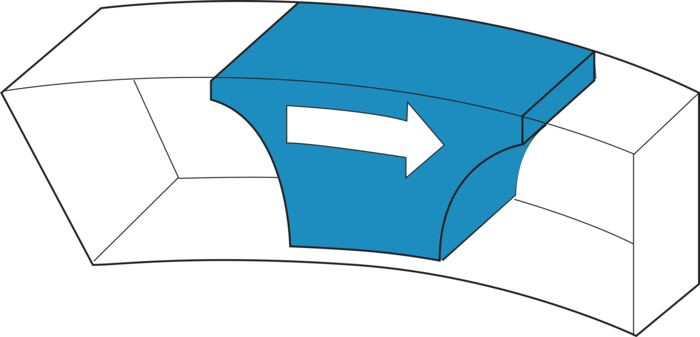
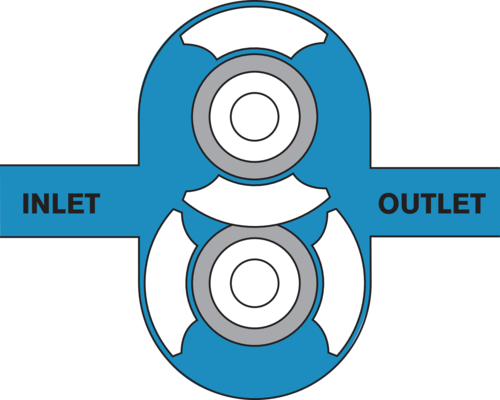
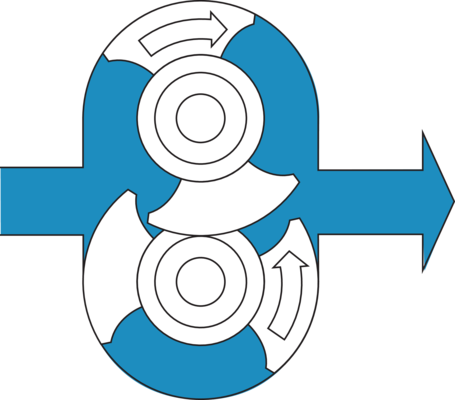
The Waukesha Universal Series uses the time-tested circumferential-piston operating principle. Arc-shaped "pistons" (rotor wings) travel in annular cylinders machined into the pump body, creating a long sealing path between inlet and outlet that reduces slippage and produces a smooth flow of product — without destructive pulses, pressure peaks, valves, or complex parts.
Because the rotors are made from Waukesha's non-galling Alloy 88, they can run at exceptionally close clearance with the 316L stainless fluid head without galling or seizing should inadvertent pressure surges cause contact. The close clearances combined with the long sealing path yield low-slip operation even on low-viscosity fluids — which translates to high efficiency, reliable priming, metering capability, and tight flow control.
Large fluid cavities in the rotors, paired with generous anti-cavitation ports, let the Universal Series efficiently pump high-viscosity fluids, slurries, and liquids carrying large chunks or particulates.
Because the Waukesha Cherry-Burrell design runs with no bearings in the pumped fluid, no sliding or rolling contact, and no rotor-to-rotor contact, the Universal 1 delivers long service life even under severe or abrasive conditions.

The Universal 1 scales from the 006-U1 (ideal for dosing and small transfer duty) up to the 320-U1 (bulk transfer and process loop). Displacement per revolution, nominal capacity, and maximum pressure for each model shown below.
| Model | Displacement per Revolution | Nominal Capacity to | Maximum Pressure |
|---|---|---|---|
| 006-U1 | 0.0082 gal (0.031 L) | 6 GPM (1.3 m³/hr) | 200 PSI (13.8 bar) |
| 015-U1 | 0.0142 gal (0.054 L) | 9 GPM (2.0 m³/hr) | 200 PSI (13.8 bar) |
| 018-U1 | 0.029 gal (0.110 L) | 17 GPM (3.8 m³/hr) | 200 PSI (13.8 bar) |
| 030-U1 | 0.060 gal (0.227 L) | 36 GPM (8.2 m³/hr) | 200 PSI (13.8 bar) |
| 040-U1 | 0.076 gal (0.288 L) | 45 GPM (10.2 m³/hr) | 150 PSI (10.3 bar) |
| 060-U1 | 0.153 gal (0.579 L) | 90 GPM (20.4 m³/hr) | 200 PSI (13.8 bar) |
| 130-U1 | 0.254 gal (0.961 L) | 150 GPM (34.1 m³/hr) | 200 PSI (13.8 bar) |
| 220-U1 | 0.522 gal (1.976 L) | 310 GPM (70.4 m³/hr) | 200 PSI (13.8 bar) |
| 320-U1 | 0.754 gal (2.854 L) | 450 GPM (102 m³/hr) | 200 PSI (13.8 bar) |
Nominal capacity and maximum pressure ratings per Waukesha Cherry-Burrell. Actual performance depends on viscosity, product properties, and system conditions — Triplex Sales application engineers will size and specify the correct model for your duty point.
Every Universal 1 is configured to duty. Select the seal, elastomer, connection, and gearcase that fit your fluid, temperature, and cleaning regime.
From pilot-scale dosing to full production transfer, the U1 runs in every corner of the sanitary processing world.
Everything our application engineers use to spec, quote, and troubleshoot the Universal 1 — made available to you.
If your question isn't here, call a Triplex Sales application engineer — we size, spec, and troubleshoot U1s every day.
Give us your duty — fluid, flow, pressure, temperature, and cleaning regime — and a Triplex Sales application engineer will confirm the right U1 model, seal, and rotor configuration. Same-day quotes on most duty points.
Tell us what you are trying to move, control, heat, cool or replace. We will help narrow the path.