01
Viscous Products
When you're moving anything above roughly 300 cP — mayo, caramel, peanut butter, lotions, emulsions — rotary lobe delivers consistent flow a centrifugal simply can't.
The complete line of sanitary positive displacement pumps for food, beverage, dairy, pharmaceutical and personal care manufacturers — backed by on‑hand inventory, technical sizing support, and rapid parts shipping from Schaumburg, IL.
Every rotary lobe pump we carry is selected, sized, and supported by our technical team. From the original Universal 1 that set the sanitary standard to the premium Universal 3 with front-loading seal access, each model solves a specific processing challenge.
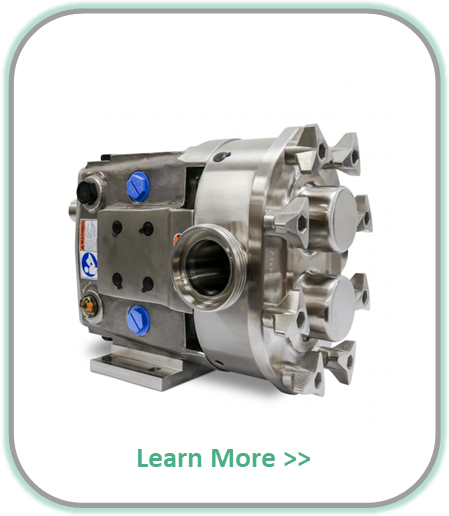
The original "Can Do" pump. Designed for Clean Out of Place (COP) applications, the U1 has been the sanitary processing standard for decades — still spec'd today for its proven reliability and straightforward serviceability.
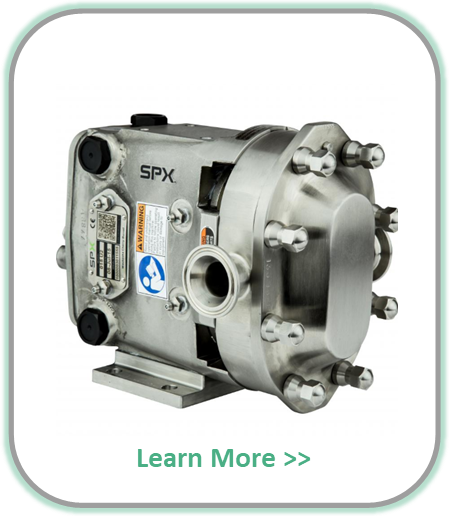
Purpose-built for Clean In Place (CIP) applications. The U2 combines versatility with performance-enhancing and cleanability features — our recommended default for modern hygienic processing plants.
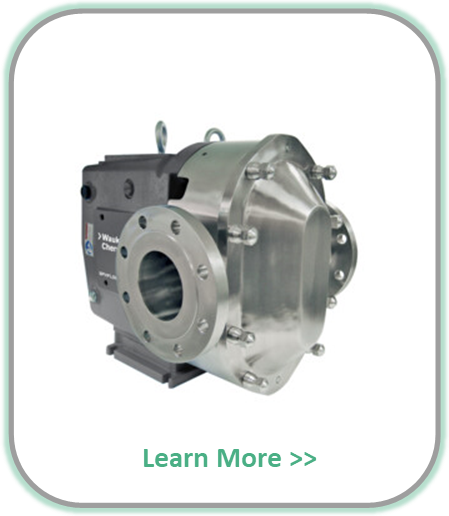
Purpose-built for heavy-duty industrial applications. Long-life internals and installation flexibility let this robust PD pump run at pressures of up to 500 psi.
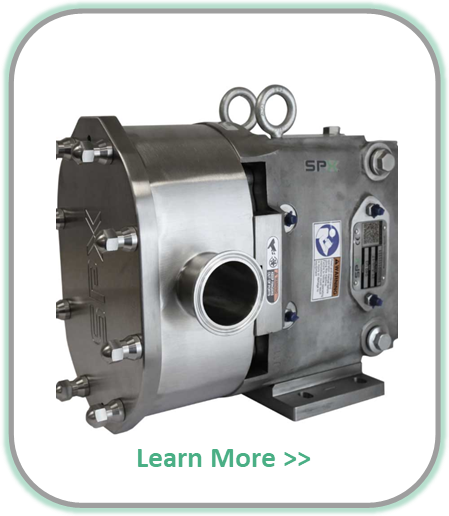
The premium Universal family option, built around hygienic performance, front-loading seal access, and service-friendly design for demanding sanitary processing.
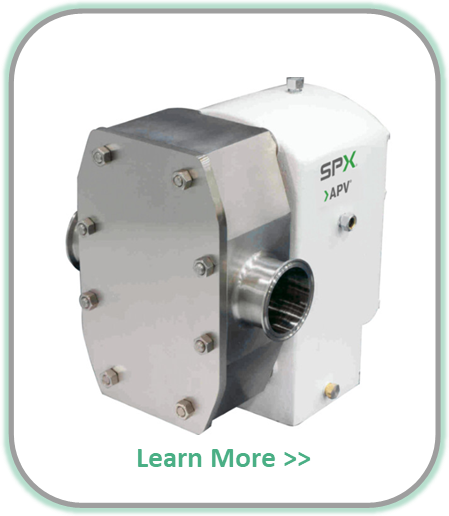
Our most economical offering. Ideal for applications where metal rotors aren't quite right — dough, yeast, dairy. Unique features include a degassing cover for air-entrained products.
Use a sanitary rotary lobe pump when you need positive-displacement flow for viscous, shear-sensitive, or particulate-bearing products in hygienic processing. For thin, high-flow transfer, compare centrifugal first; for one pump covering a wide viscosity range or process plus CIP duties, compare twin screw.
| Application signal | Likely direction | Triplex next step |
|---|---|---|
| Viscous product, gentle handling, solids, or accurate metering | Rotary lobe pump | Review Waukesha Universal and APV R Series options below. |
| Low-viscosity, high-flow liquid transfer | Centrifugal pump | Compare efficiency, head, sanitary requirements, and total duty cycle. |
| Wide viscosity range or process + CIP with one pump | Twin screw pump | Check whether the higher upfront cost simplifies the system. |
Sanitary positive-displacement pumps — including rotary lobe and circumferential piston designs — are often the first place to look when the product is viscous, shear-sensitive, contains soft particulates, or needs controlled flow against changing pressure. Twin screw pumps enter the conversation when the same pump may need to transfer product at one speed and move cleaning solution at a much higher speed, or when the process covers a wide viscosity range. Centrifugal pumps remain the usual first choice for clean, lower-viscosity liquids where efficient continuous flow is the main requirement.
Particle size, firmness, concentration, pump speed, rotor style, clearances, and allowable product damage still matter. "Gentle handling" is application-specific; real product damage depends on speed, slip, viscosity, pressure differential, and product sensitivity.
If the application is borderline, Triplex can size more than one pump style and compare the trade-offs before a model is selected.
| Application signal | Usually compare first | Why |
|---|---|---|
| Viscous, shear-sensitive, or soft-particulate sanitary product | Sanitary PD pump | Positive-displacement flow with application-specific rotor, speed, and clearance review. |
| One pump expected to support product transfer and CIP flow | Twin screw | Wider speed range may support both operating points when the system allows it. |
| Thin, clean liquid at higher flow | Centrifugal | Often simpler and more efficient for low-viscosity transfer. |
| Product viscosity changes significantly during the process | Sanitary PD or twin screw | Selection depends on viscosity range, pressure, suction conditions, and cleaning duty. |
| Unsure which pump style fits | Triplex sizing review | Application details matter more than generic pump categories. |
For a cleaner recommendation, send the product, flow rate, viscosity at pumping temperature, temperature range, pressure or head, suction conditions, solids or particulates, cleaning method, seal expectations, and any existing pump nameplate or photos. If the product is shear-sensitive or texture-critical, include that too — the right pump is not just a GPM decision.
Not sure where to start? Here's how the five models stack up across the specs that matter most when you're specifying a sanitary PD pump.
| Specification | Universal 1 | Universal 2 | U2 ND | Universal 3 | APV R |
|---|---|---|---|---|---|
| Best For | Legacy COP plants | Modern CIP plants | Industrial / high pressure | High-pressure sanitary | Dough, yeast, dairy |
| Cleaning Method | COP | CIP | CIP | CIP / COP | COP |
| Pressure Rating | Standard | Standard | Up to 500 psi | High pressure | Standard |
| Rotor Material | Alloy 88 | Alloy 88 | Alloy 88 | Alloy 88 | Elastomer |
| 3-A Sanitary | ✓ | ✓ | ✓ | ✓ | ✓ |
| Degassing Cover | — | — | — | — | ✓ |
| Internal Seal | — | — | — | ✓ | — |
Rotary lobe pumps aren't the right answer for every process, but when they are, nothing else comes close. Here's when to spec one.
When you're moving anything above roughly 300 cP — mayo, caramel, peanut butter, lotions, emulsions — rotary lobe delivers consistent flow a centrifugal simply can't.
Yogurt, cottage cheese, creams and finished emulsions degrade under high shear. Gentle rotor action preserves product integrity and texture.
Fruit chunks, cheese curds, meat pieces, pulp. Non-contacting lobes pass inclusions gently without pulverizing them.
Positive displacement means near-linear flow vs. RPM. Dial in precise dosing without complicated feedback control.
Our rotary lobe pumps run in production lines across North America. These are the industries where they do their best work.
Sauces, dressings, fillings, soups, spreads, condiments, bakery mixes.
Milk, cream, yogurt, cottage cheese, ice cream base, cream cheese.
Juices, concentrates, syrups, flavorings, functional drinks.
Slurries, creams, gels, suspensions, fermentation transfers.
Lotions, shampoos, conditioners, gels, emulsions, pastes.
The questions we get most often from engineers, maintenance teams and procurement spec‑ing rotary lobe pumps.
For Waukesha and APV rotary lobe pumps that have been in service for years, a Triplex site survey looks beyond the nameplate. We help identify seal failure patterns, rotor and elastomer compatibility issues, outdated configurations, spare-parts gaps, and pumps that may be better rebuilt, reconfigured, or replaced.
That creates a cleaner plan for uptime, parts planning, and replacement priorities across your installed PD pump base.
Whether you need a replacement pump, a complete system, or just a second opinion on your current setup — we'll meet you where you are. Technical sizing, quoting, and follow-through from a team that's been doing this since 1978.
Tell us what you are trying to move, control, heat, cool or replace. We will help narrow the path.