The original
Waukesha Universal 1
The can-do PD pump. 9 sizes, 200 PSI, 3-A sanitary, COP cleanable.
Explore U1The Waukesha Universal 2 is the industry's benchmark for automated, validated clean-in-place sanitary pumping. Fourteen sizes, flows to 660 GPM, pressures to 500 PSI, Tru-Fit ports, a full seal lineup for every duty, and the same legendary Alloy 88 rotors — engineered for process lines that demand CIP cleanability at full duty.
The Universal 2 is what you specify when your process requires automated, validated CIP cleaning — dairy, beverage, pharmaceutical, and high-care food production lines where breaking the pump down between batches isn't an option. Every detail of the U2 — seal cavity geometry, port profile, rotor clearance, drain angle — is engineered so a CIP loop can clean and validate the pump without disassembly.
Beyond CIP, the U2 is the U1's big brother in raw capability: more than double the pressure rating, 50% more flow, heavier shafting, and five additional sizes covering the high end of process duty. Like every Waukesha lobe pump, it runs on proprietary non-galling Alloy 88 rotors.
Fully drainable interior, flushed seal cavity, crevice-free ports.
Long transfer lines, homogenizer feed, high-pressure process loops.
Factory-machined sanitary connections for reliable 3-A compliance.
Single mechanical, double mechanical, knife seal, or high-pressure barrier seal per duty.
The U2 is a generational redesign of the Waukesha lobe pump platform. Compared to the U1, every critical feature — seal, ports, rotor clearance, gearcase, cover — has been upgraded specifically for sanitary CIP service.
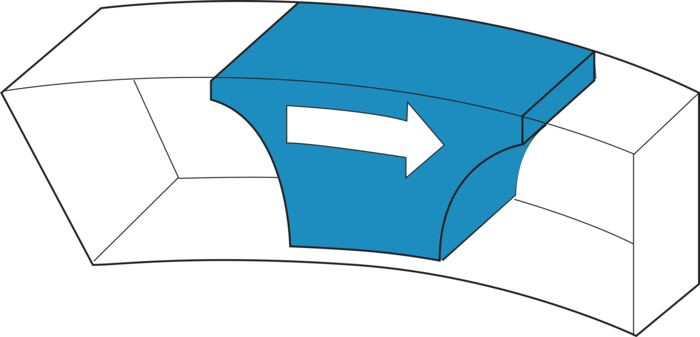
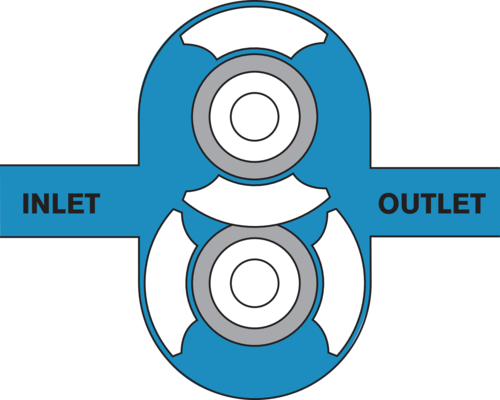
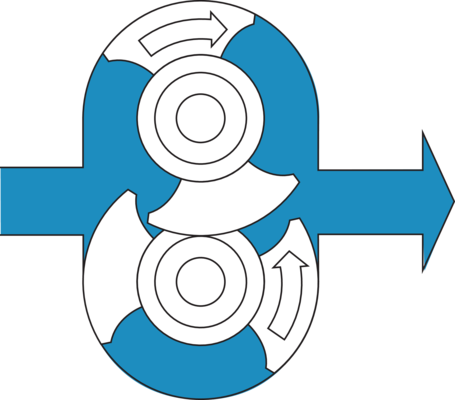
Rotary lobe pumps are positive displacement pumps consisting of two counter-rotating rotors inside a close-tolerance pump body. As the rotors turn, they create successive pockets of fluid trapped between the rotor lobes and the pump casing.
These pockets move fluid smoothly from suction to discharge with almost no pulsation. Because the rotors are driven externally through timing gears, they never touch each other or the pump body — eliminating internal wear and allowing Waukesha's low-shear, gentle product handling.
The tight running clearances between the rotors and the pump body are what make the pump self-priming and volumetrically efficient. Those clearances are machined to millionths of an inch, which is why Alloy 88 rotors are essential — 316 stainless rotors would gall and seize on contact.
In the Universal 2, those same running clearances are tuned slightly more generously than the U1's, because CIP cleaning requires a minimum velocity of cleaning fluid past every product-contact surface. The U2's rotor profile, timing gear clearance, and body geometry are all engineered to hit that velocity target throughout the pump.

The U2 scales from the 006 (pilot and dosing) up to the 370 (large-volume production and tank transfer). Alloy 88 rotors, Tru-Fit ports, and 3-A CIP geometry are standard across the range.
| Model | Displacement per Revolution | Nominal Capacity to | Maximum Pressure |
|---|---|---|---|
| 006-U2 | 0.0082 gal (0.031 L) | 8 GPM (1.8 m³/hr) | 300 PSI (20.7 bar) |
| 015-U2 | 0.0142 gal (0.054 L) | 11 GPM (2.5 m³/hr) | 250 PSI (17.2 bar) |
| 018-U2 | 0.029 gal (0.110 L) | 20 GPM (4.5 m³/hr) | 200 PSI (13.8 bar) |
| 030-U2 | 0.060 gal (0.227 L) | 36 GPM (8.2 m³/hr) | 250 PSI (17.2 bar) |
| 040-U2 | 0.076 gal (0.288 L) | 45 GPM (10.2 m³/hr) | 150 PSI (10.3 bar) |
| 045-U2 | 0.098 gal (0.371 L) | 58 GPM (13.2 m³/hr) | 450 PSI (31.0 bar)* |
| 060-U2 | 0.153 gal (0.579 L) | 90 GPM (20.4 m³/hr) | 300 PSI (20.7 bar) |
| 130-U2 | 0.253 gal (0.958 L) | 150 GPM (34.1 m³/hr) | 200 PSI (13.8 bar) |
| 180-U2 | 0.380 gal (1.438 L) | 230 GPM (52.2 m³/hr) | 450 PSI (31.0 bar)* |
| 210-U2 | 0.502 gal (1.900 L) | 300 GPM (68.1 m³/hr) | 500 PSI (34.5 bar)* |
| 213-U2 | 0.502 gal (1.900 L) | 300 GPM (68.1 m³/hr) | 500 PSI (34.5 bar) |
| 220-U2 | 0.521 gal (1.972 L) | 310 GPM (70.4 m³/hr) | 300 PSI (20.7 bar) |
| 320-U2 | 0.752 gal (2.847 L) | 450 GPM (102 m³/hr) | 300 PSI (20.7 bar) |
| 370-U2 | 1.099 gal (4.160 L) | 660 GPM (150 m³/hr) | 200 PSI (13.8 bar) |
* Higher-pressure models require specific seal and construction configurations. Nominal capacity and maximum pressure ratings per Waukesha Cherry-Burrell. Actual performance depends on viscosity, product properties, and system conditions — Triplex Sales application engineers will size and specify the correct model for your duty point.
The U2 supports deep configuration of every critical component — ports, rotor style, rotor clearance, elastomer, seal, cover, gearcase — so the pump matches your process and your cleaning chemistry exactly.
Each button opens the Model & Performance Center with this pump family, model, and Performance Curve file type already selected.
Curves are manufacturer-published ITT Waukesha Cherry-Burrell documents. Confirm the duty point and final selection with Triplex.
Anywhere product goes from fermenter to filler, homogenizer to heat exchanger, or tank to tote — and the CIP loop has to clean the pump in place.
Everything our application engineers use to spec, quote, and troubleshoot the Universal 2.
Give us your duty — fluid, flow, pressure, temperature, and CIP chemistry — and a Triplex Sales application engineer will confirm the correct U2 model, rotor clearance, port style, and seal configuration. Same-day quotes on most duty points.
Use the Triplex WCB Model Center to filter Universal pump curve PDFs, STEP files, SolidWorks files, and shared dimensional drawings by series and model.
Open the WCB Model CenterTell us what you are trying to move, control, heat, cool or replace. We will help narrow the path.